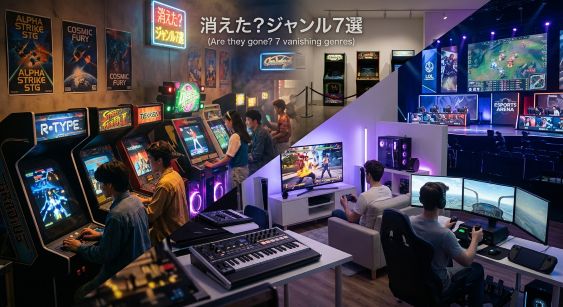
Looking back at the history of video games, there are numerous genres that, despite once being such massive hits that they came to symbolize their era, have since faded from the limelight.
Why did those genres that captivated people at arcades and on home video game consoles from the 1980s through the 2000s eventually lose their momentum?
In this article, we’ll highlight seven game genres that were once all the rage but are now said to be “nearly extinct.” We’ll provide a detailed explanation of the reasons behind
their decline, as well as their current standing in the industry and how they’ve managed to survive.
- 1. Side-Scrolling Shooters (STG) | “Beginners Turning Away” Due to Increasing Difficulty
- 2. Competitive Fighting Games (Fighting Games) | Rising Barriers to Entry and the Decline of Arcades
- 3. Music Games | Larger Arcade Cabinets and the Shift to Smartphone Apps
- 4. Racing Games (Arcade-Style) | The Limits of Realism and the Shift Toward Open-World Gameplay
- 5. RTS (Real-Time Strategy) | Excessively High Control Requirements and the Shift Toward MOBA
- 6. Flight Simulators | Demanding System Requirements and the FPS Boom
- 7. Real Pinball | Poor Installation Efficiency and the Shift to Digital
- Summary: Game genres are not “dying out” but rather “evolving and diversifying”
1. Side-Scrolling Shooters (STG) | “Beginners Turning Away” Due to Increasing Difficulty
In the 1980s, side-scrolling and vertical-scrolling shoot ’em ups (STGs) reigned supreme in the arcade market.
The market pioneered by *Space Inverse* and *Xevious* entered its golden age with the release of masterpieces such as *Gradius*, *R-TYPE*, and *Darius*.
However, the market began to shrink rapidly starting in the mid-1990s.
Main Reasons for Decline
- The Rise
of 3D Technology: With the introduction of the PlayStation and Sega Saturn in the mid-1990s, shoot 'em ups—which relied primarily on 2D graphics—began to look visually outdated. - With the emergence of bullet-hell games and to meet the demands of difficulty-inflation
enthusiasts (core users), “bullet-hell shooters”—which fill the entire screen with bullets—became mainstream.
As a result, casual players and beginners were completely shut out of the genre. - Declining Profit Margins:
In the arcade market, as players spend more time playing, store profitability declines, which has accelerated the trend toward higher difficulty levels.
Current Situation
Although it has disappeared as a major title for home video game consoles, development remains vibrant in the indie game market, on Steam, and among doujin circles.
It also continues to enjoy a strong following as part of the “danmaku” culture, exemplified by the mobile game series *Touhou Project*.
2. Competitive Fighting Games (Fighting Games) | Rising Barriers to Entry and the Decline of Arcades
Released in 1991, *Street Fighter II* sparked a global social phenomenon and launched a massive boom in head-to-head fighting games.
Classic titles such as *Virtua Fighter*, *KOF (The King of Fighters)*, and *Tekken* were released one after another.
However, behind this explosive boom, the “challenges inherent to competitive games”—which the genre itself faces—began to surface.
Main Reasons for Decline
- With increasingly complex controls, the rising difficulty
of combo inputs, and lengthy aerial combos, there are now too many elements players must master to win. - "Newbie hunting" (defeats due to an overwhelming skill gap) frequently occurred in the community
arcade, which rejected new players, preventing them from sticking around. - Taking advantage of the
boom in the mass production of games with similar titles, a flood of low-quality fighting games hit the market, leading to user fatigue.
Current Situation
Since the start of the 2020s, the series has shown signs of a resurgence. In
particular, *Street Fighter 6* attracted a large number of new players by introducing “Modern Controls” designed for beginners. It is once again generating significant excitement as a flagship title in esports.
3. Music Games | Larger Arcade Cabinets and the Shift to Smartphone Apps
Starting with the release of *Beatmania* in 1997, music games—including *Dance Dance Revolution* (DDR) and *Taiko no Tatsujin*—completely transformed the arcade scene.
While the game attracted casual players with its exhilarating physical movement and intuitive controls, changes began to occur in how stores set up the machines starting in the late 2000s.
Main Reasons for Decline
- The Difficulty of Porting to Home Consoles Due to Dependence on Dedicated Controllers: Because the game required
dedicated hardware and special controllers, a full port to home consoles was difficult and presented a significant challenge. - Decline in Amusement Facilities
: As the number of arcades has decreased year by year, the venues where people can enjoy these experiences have disappeared. - User Shift
to Smartphone Games: Free-to-play, easy-to-play smartphone music games like *Love Live! School Idol Festival* and *Project Sekai* have taken the market by storm.
Current Situation
While the experiential value offered by large arcade machines at amusement facilities still remains, the market’s focus has shifted entirely to smartphone apps.
4. Racing Games (Arcade-Style) | The Limits of Realism and the Shift Toward Open-World Gameplay
In the 1990s, racing games were the genre that most clearly demonstrated the evolution of graphics technology.
Titles such as *Ridge Racer* and *Gran Turismo* were iconic examples of graphics that showcased the capabilities of the hardware.
However, as the evolution of graphics begins to plateau, it will become difficult for traditional “circuit-based” racing games to maintain demand.
Main Reasons for Decline
- Soaring
Development Costs: The more we pursued realistic graphics, the more the costs for vehicle licensing and 3D model production skyrocketed. - The Evolution Toward Open-World (Driving Games): User preferences have shifted from a style involving laps around a
fixed course to a format where players can freely explore vast maps, as seen in *Forza Horizon*. - On Nintendo's dominant
home console platform, the "Mario Kart" series has virtually monopolized the casual gaming market, making it difficult for other companies to enter the market (which is one of the reasons why classic fast-paced racing games, such as "F-ZERO," have been absent for so many years).
Current Situation
With the market split between the simulator-style *Gran Turismo* and the casual *Mario Kart*, the pure arcade-style racing games once found in arcades have all but disappeared.
5. RTS (Real-Time Strategy) | Excessively High Control Requirements and the Shift Toward MOBA
RTS (real-time strategy) games have been a driving force behind the evolution of PC gaming since its early days.
Games like *Age of Empires*, *StarCraft*, and *Warcraft*—which feature gameplay where players devise strategies while controlling units in real time—enjoyed immense popularity, particularly in the West.
However, the RTS genre would end up losing market share to a “new genre that it itself helped create.”
Main Reasons for Decline
- The abnormally high
number of required operations (APM) made multitasking—which required performing hundreds of operations per minute (200–300 APM)—necessary, and this proved too difficult for the general public. - Each match requires you to juggle
strategy, base management, and combat controls all at once, so it’s not a game you can play casually. - The Birth
of MOBAs: The MOBA genre—featuring games like *League of Legends* (LoL) and *Dota 2*, which originated as mods for *Warcraft III*—emerged. Players flocked en masse to MOBAs, which stripped away the “base-building” elements found in RTS games and focused exclusively on controlling a single character.
Current Situation
In the world of PC gaming, the spotlight for competitive and strategic gameplay has shifted entirely to MOBAs and FPS/TPS games.
Today, pure RTS games have become a niche genre catering to a small but dedicated fan base.
6. Flight Simulators | Demanding System Requirements and the FPS Boom
Flight simulators have been pushing the limits of PC hardware since the 1980s.
Titles such as *Microsoft Flight Simulator*, as well as *F-15* and *IL-2 Sturmovik*—which feature fighter jets—have attracted a passionate fan base due to their high level of realism.
Main Reasons for Decline
- The demands on PC specifications were so high that running the
top-tier graphics and physics simulations required an extremely expensive PC setup. - The extreme complexity
of the controls required knowledge comparable to that of a real pilot, as well as a specialized joystick, making the barrier to entry far too high. - With the rise of first-person shooters (FPS), game developers began shifting
their resources toward FPS titles that offered a more intuitive and exhilarating experience.
Current Situation
“Microsoft Flight Simulator,” which debuted in 2020 with ultra-high-performance graphics, generated a great deal of buzz; however, from a broader market perspective, the high barriers to entry in terms of development costs and technical expertise have led to a situation where the market is virtually monopolized by a single major company.
7. Real Pinball | Poor Installation Efficiency and the Shift to Digital
From the 1970s through the 1990s, pinball machines were a massive entertainment industry, with more than 200,000 units produced annually.
However, they were rapidly supplanted by the evolution of video games, which relied on electronic circuits and monitors.
Main Reasons for Decline
- Low profitability per square foot: Despite taking up a significant amount of
physical space, only one person could play at a time, resulting in lower profitability compared to video games. - High Maintenance and Manufacturing Costs: Because the device contained many
mechanical components, it was prone to breakdowns, resulting in a heavy burden in terms of parts manufacturing and maintenance. - A Series of Withdrawals
by Major Manufacturers Well-known manufacturers such as Bally and Williams have withdrawn from the pinball business one after another.
Current Situation
While it’s now easy to play “digital pinball” (as a mini-game in apps or console games), a few manufacturers—such as the American company “Stern Pinball”—continue to produce physical pinball machines for collectors and the affluent.
Summary: Game genres are not “dying out” but rather “evolving and diversifying”
Each of the seven genres featured here was once at the top of the gaming industry.
At first glance, it may seem as though the genre has “disappeared,” but a closer look at the reasons for its decline reveals clear structural changes, such as “new players being driven away by the increasing difficulty,” “the widespread adoption of smartphones,” and “the evolution into other genres (e.g., RTS → MOBA).”
Many of these declining genres have not disappeared entirely, but continue to survive in the following ways.
- Legacy in the Indie Game Market (e.g., STG, RTS)
- Reevaluation Through the Introduction of Beginner-Friendly Systems (e.g., Modern Controls in Fighting Games)
- Shift to a smartphone app platform (e.g., music games)
Even genres you might feel you “haven’t seen much of lately” are still alive and well in today’s gaming experience, albeit in a different form. Why not check out the latest titles to see how the genres you
once loved have evolved?