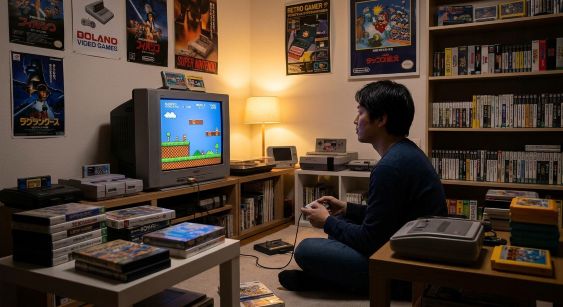
- “Japanese Retro Games” Captivating the World
- What exactly is the definition of a retro game?
- Why Now? Four Reasons Japanese Retro Games Are Being Reappraised Worldwide
- The Background of the Soaring Retro Game Market and Collector Demand
- They defined the Showa and Heisei eras! Iconic consoles that represent retro gaming
- How to Play Retro Games Safely and Conveniently in the Reiwa Era
- Summary: Japanese Retro Games Are a “Timeless Culture” the World Can Be Proud Of
“Japanese Retro Games” Captivating the World
In recent years, there has been a sharp increase in the number of foreign tourists visiting shops in Akihabara and in the number of people encountering “Japanese Retro Games” through gaming commentary videos on YouTube.
Titles from systems that once captivated children—such as the Family Computer (Famicom), Super Famicom, Mega Drive, and the original PlayStation—are being reevaluated as global cultural heritage and works of art, transcending the label of mere “old games.”
Why are retro games—with their pixel art and chip tunes (8-bit sound)—gaining renewed attention now, in an era of overwhelming technological advancement?
In this article, we’ll delve into the background of the retro gaming boom, its appeal, the reasons behind the price surge, and the latest ways to enjoy these games today.
What exactly is the definition of a retro game?
While there is no clear-cut definition of a retro game, within the gaming industry and among collectors, the term generally refers to “game software and hardware released more than 20 years ago.”
Specifically, this includes hardware from the following generations:
- 8-bit / 16-bit Generation
Family Computer, PC Engine, Mega Drive, Super Famicom - 32-bit / 64-bit Generation
PlayStation, Sega Saturn, Nintendo 64 - Early 2000s Generation
Nintendo GameCube, PlayStation 2, Dreamcast, Game Boy Advance
Nowadays, even games released in the early 2000s are beginning to be recognized as “retro games.”
Why Now? Four Reasons Japanese Retro Games Are Being Reappraised Worldwide
① “Simplicity” and “Responsiveness” Not Found in Modern Games
Modern AAA titles (massive-scale games) are characterized by cinematic graphics, vast open worlds, and hundreds of hours of gameplay.
On the other hand, many players find that “the controls are hard to learn” or that “the tutorials are too long.”
With retro games, you can start playing within just a few seconds of turning them on, and with fewer buttons, they offer an intuitive experience.
Perhaps the pure fun inherent in gaming—the ability to “easily achieve a sense of accomplishment and exhilaration”—is a perfect fit for the busy lifestyles of modern people.
② “Pixel Art” and “Iconic BGM” Born from Limitations
Developers back then had to bring characters and game worlds to life within extremely limited memory capacity.
The beautiful pixel art (dot art) and catchy chip-tune music born from these constraints are now highly regarded as the “aesthetics of constraint.”
This respect for the culture is also why indie game developers are increasingly adopting retro-style graphics.
③ Establishment as “Y2K and ‘emo’” Culture Among Gen Z and Gen Alpha
For teens and people in their 20s who are unfamiliar with Showa and Heisei-era culture, retro games are seen not as “nostalgic” but as “emo and fresh.”
Rough polygons and the distinctive scan lines of CRT (cathode ray tube) monitors are also beloved as fashion icons that look great on social media (such as Instagram and TikTok).
④ Overwhelming Trust in “JRPGs” and Japanese Gaming Culture Overseas
From the 1980s through the 1990s, titles produced by Nintendo, Sega, Square (now Square Enix), Capcom, Konami, and others laid the foundation for the global gaming industry.
JRPGs and action games such as *Dragon Quest*, *Final Fantasy*, *The Legend of Zelda*, and *Mario* are cherished childhood memories and symbols of aspiration for gamers overseas as well.
The Background of the Soaring Retro Game Market and Collector Demand
Currently, the market value of retro games is rising rapidly, and it is not uncommon for certain ultra-rare titles or copies in excellent condition to be traded for hundreds of thousands to millions of yen.
The main reasons for this market surge are as follows.
| Factors Behind the Price Surge | Content and Details |
| The Explosion in Inbound Demand | Foreign tourists visiting Japan are buying large quantities of physical goods at places like “Akihabara” and “Nakano Broadway.” |
| The Decline in the Number of Well-Preserved Items Still in Existence | The number of “complete sets”—those that come with their original cardboard boxes and instruction manuals—is decreasing year by year due to wear and tear and disposal, making them increasingly rare. |
| Recognition as an Investment and Asset | The growing popularity of grading (condition assessment) by specialized appraisal organizations (such as VGA and Wata Games). |
| Digitization and the Desire to Own | Precisely because we’re in the heyday of subscription services, there’s a growing desire to own “physical packages (the actual items).” |
Among overseas collectors, these games are particularly popular because “the Japanese versions are in excellent condition” and “the packaging design and obi are cool.”
They defined the Showa and Heisei eras! Iconic consoles that represent retro gaming
- Family Computer (Nintendo / Released in 1983)
This legendary console pioneered Japan’s home video game culture.
It gave birth to historic masterpieces such as *Super Mario Bros.* and *Dragon Quest*. - Mega Drive (Sega / Released in 1988)
Equipped with a 16-bit CPU, it sparked a massive craze overseas—particularly in the North American Genesis market—with its fast-paced action and arcade-style ports. - Super Famicom (Nintendo / Released in 1990)
Its graphical capabilities evolved significantly, delivering beautiful pixel art and rich sound.
It ushered in the golden age of JRPGs with titles such as *Chrono Trigger* and *Final Fantasy VI*. - PlayStation (Sony / Released in 1994)
This console heralded the dawn of the 3D graphics era.
Titles such as *Final Fantasy VII* and *Resident Evil* dramatically transformed the way games were presented.
How to Play Retro Games Safely and Conveniently in the Reiwa Era
For those who think, “I’d like to play these games again after a long time, but buying the actual consoles and games is a hassle…,” there are several ways to enjoy them that are tailored to today’s environment.
① Use an official subscription service
This is the easiest and safest method.
- Nintendo Switch Online
Play Famicom, Super Famicom, and Game Boy titles with a monthly subscription (Nintendo 64, Mega Drive, and GBA titles are also supported with an add-on pack). - PlayStation Plus
Features a Classics catalog offering classic titles from the original PlayStation, PlayStation 2, and PSP.
② Buy a retro-reissue mini console
Retro-reissue consoles like the “Nintendo Classic Mini: Family Computer,” “Mega Drive Mini,” and “PC Engine mini” are palm-sized devices that connect to your TV via HDMI.
They come pre-loaded with dozens of classic games, so you can start playing right away.
③ Play Remastered and Remade Versions
We also recommend playing titles like *Dragon Quest III HD-2D* and *Final Fantasy VII Remake*, which retain the charm of the original while updating the graphics and controls to modern standards.
Summary: Japanese Retro Games Are a “Timeless Culture” the World Can Be Proud Of
The Japanese retro gaming boom is not merely a passing fad of nostalgia.
Precisely because we live in an era surrounded by advanced technology, the simple gaming experiences that anyone can get hooked on—along with the pixel art and sound effects crafted with ingenuity by the creators of that era—continue to be cherished worldwide as a new cultural phenomenon.
If you have any game cartridges gathering dust in your closet, why not take them out and give them a try, or check out the re-releases available on the latest hardware?
The “true fun” that hasn’t lost its luster even when played today is waiting for you there.





'%3E%3Cpath%20stroke='%23000'%20stroke-width='4'%20d='m-35-37-13%2020m5%203%2013-20m5%203-13%2020m63%2042%206-9m1-2%206-9m5%203-6%209m-1%202-6%209m5%203%206-9m1-2%206-9m-96%200%2013%2020m5-3-6-9m-1-2-6-9m5-3%2013%2020m63-42-6-9m-1-2-6-9m5-3%2013%2020m5-3-6-9m-1-2-6-9'/%3E%3Ccircle%20r='24'%20fill='%23cd2e3a'/%3E%3Cpath%20fill='%230047a0'%20d='M0%200a12%2012%200%201%201%2020%2013%2024%2024%200%201%201-40-26A12%2012%200%201%200%200%200'/%3E%3C/g%3E%3C/svg%3E)