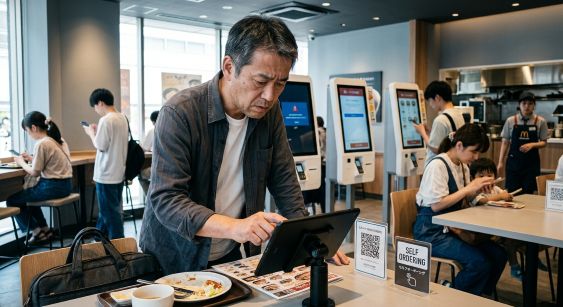
“When you walk into a restaurant, you scan a QR code with your smartphone and place your order on a touchscreen. When you go to a supermarket or convenience store, you stand in line at a self-checkout kiosk where you do everything yourself—from scanning product barcodes to completing payment—”
Under the guise of addressing severe labor shortages and improving operational efficiency in retail stores, a “wave of self-service” is sweeping through our daily lives at a breakneck pace.
However, behind this seemingly convenient system, I suspect there are many consumers who, far from reaping the benefits of digitization, are instead facing invisible workloads and psychological stress—and feeling “exhausted.” In today’s service environment, a series of tasks that should
rightfully be handled by store staff are suddenly being passed entirely onto the customers. Why exactly is this “self-service fatigue” becoming
so widespread?
In this article, I’d like to take an in-depth look at the background of this structural problem and the future direction the service industry should aim for, while sharing the real voices of consumers heard on the front lines.
- “Why Should Customers Make Store Employees Work for Free?” A Strong Sense of Unease About Unpaid Substitute Work
- The “Learning Curve” and Confusion Caused by an Inconsistent User Interface (UI)
- The Loss of “Human Warmth” | The Emotional Value of Customer Service and the Feeling of Loneliness
- Why Are Companies Moving Toward Self-Service? The Dilemma on the Front Lines
- The Future of Services | The “Harmonious Coexistence” of People and Technology
- Summary: Aiming for the “True Customer Experience” Beyond Efficiency
“Why Should Customers Make Store Employees Work for Free?” A Strong Sense of Unease About Unpaid Substitute Work
With the growing popularity of self-checkout and touchscreen ordering, the most common question and complaint we hear is the fundamental one: “Isn’t this the store’s job, not the customer’s?”
A scenario in which professional customer service has been reduced to unpaid “labor”
Traditionally, tasks such as operating the cash register, taking orders, and bagging merchandise were handled by trained customer service professionals.
Customers presumably paid for these services as part of the price of their purchases or service fees.
However, with the increasing prevalence of self-service today, a situation has emerged in which customers are effectively being made to “perform” the roles of cashiers and floor staff without compensation. Many consumers feel uneasy about the fact that the “hospitality” they should
rightfully expect has disappeared, leaving only the performance of routine tasks.
The pressure and mental stress of being held personally responsible for mistakes
Since you are performing the work yourself, all responsibility for any errors will fall back on the customer.
- "What should I do if I accidentally scan a product's barcode twice?"
- "If I accidentally press the wrong button on the touchscreen and end up ordering the wrong dish, it'll be my fault."
- "I feel the pressure from the stares of the people waiting in line behind me."
Being forced to shop while feeling this unnecessary anxiety and impatience is, in itself, a major source of mental stress.
Dissatisfaction stemming from the gap between “increased effort” and “soaring prices”
Even though companies are cutting labor costs to improve efficiency, this does not mean that the prices of their products are getting any lower.
On the contrary, combined with recent inflation, product prices are on the rise.
The experience of consumers—who find that “even though they have to do more work and the service requires more effort on their part, prices are going up instead of down”—is eroding their sense of satisfaction and amplifying their latent dissatisfaction.
The “Learning Curve” and Confusion Caused by an Inconsistent User Interface (UI)
More than the resistance to self-service itself, what is really wearing people down is a systemic flaw known as “inconsistent operating procedures.” Because the specifications of the
countless devices and systems out there vary from store to store, users are forced to incur unnecessary “learning costs” every time they go shopping.
“UI Hell” That Varies by Store
For example, even when it comes to something as simple as QR code ordering at restaurants, there is absolutely no standardization in the specifications.
- Store A: When you scan the QR code, you're forced to download a dedicated app.
- Store B: It opens in a browser, but you have to go through a tedious registration process first.
- Store C: No membership registration is required, but payment methods are limited to specific cashless payment options.
As a result, since users are required to follow completely different procedures every time they switch stores, they have to figure out how to use the system step by step each time.
Exclusion of the digitally underserved and older adults (digital divide)
For older adults and those with limited digital literacy—who are not accustomed to using smartphones and other digital devices in their daily lives—these “inconsistent operating methods” pose a serious problem.
Not only are they difficult to use, but they also lead to the de facto exclusion of these individuals from brick-and-mortar stores (the digital divide).
It is not uncommon for people to lose the ability to enjoy dining out or shopping due to psychological fears such as “causing trouble for store staff or those accompanying me by being unable to place an order properly” or “feeling embarrassed.”
Ignoring Errors vs. Panicking When They Occur
“Items not scanned” errors and “age verification” pop-ups frequently occur at self-checkout counters.
When the system goes down and there are no staff members in sight to assist, customers are overcome with a sense of anxiety bordering on panic. It has become a daily occurrence that these systems—which were supposedly introduced to improve
efficiency—end up taking far longer than traditional checkouts whenever they experience a glitch.
The Loss of “Human Warmth” | The Emotional Value of Customer Service and the Feeling of Loneliness
The pursuit of efficiency has not only reduced the amount of work involved.
Another aspect that cannot be overlooked is the emotional exhaustion resulting from the disappearance of “small, personal interactions” in brick-and-mortar stores.
The Value of “Omotenashi” in Customer Service
- "What's your recommendation for today?"
- "Do you think this shirt will fit me?"
- "Thank you as always."
Casual interactions and thoughtful gestures from store clerks like these were a major part of the charm of shopping and dining at brick-and-mortar stores.
Spaces where everything is mechanized and automated tend to take on a somewhat bleak and cold atmosphere in exchange for convenience.
The Isolation of the Shopping Experience and Social Loneliness
People enter the store without exchanging a word with anyone, tap away at their screens in silence, pay at the self-checkout, and leave. From the perspective of “time performance,”
this sequence of actions may be efficient.
However, in today’s society, where human connections are growing increasingly tenuous, it also serves as a factor that further isolates people.
I suspect there are quite a few people who feel a sense of emptiness at the fact that “the pursuit of convenience is, in the end, robbing us of the inherent joy and warmth of shopping.”
Why Are Companies Moving Toward Self-Service? The Dilemma on the Front Lines

Of course, stores and businesses aren’t intentionally imposing this burden on customers.
Behind this lies a severe business environment that leaves them with no choice but to keep their operations afloat.
| Reasons for Corporate Adoption | Challenges and Realities on the Ground |
| Addressing the Severe Labor Shortage | Due to the declining birthrate and aging population, it has become extremely difficult to hire part-time and temporary workers. |
| Reducing Labor and Fixed Costs | Defensive measures to keep stores afloat amid rising minimum wages and soaring raw material costs |
| Reducing Checkout Wait Times | Eliminate checkout lines during peak hours and improve customer turnover |
However, the fact that “user-friendliness from the customer’s perspective” and “the quality of the service experience” were overlooked in the process of achieving these goals has created a gap with today’s consumers.
The Future of Services | The “Harmonious Coexistence” of People and Technology
“Customer burnout” versus “store efficiency.” To resolve
this dichotomy and create a truly sustainable in-store experience, we need a new approach—one that doesn’t simply force digitalization on customers.
1. Hybrid Stores That Offer “Freedom of Choice”
Rather than shifting entirely toward a self-service model, the ideal approach is to offer both a “self-service line” for those who are comfortable with digital operations and a traditional “in-person service counter.” Allowing customers the flexibility to choose based on their mood or circumstances
on any given day helps reduce dissatisfaction.
2. “Standardization” and Simplification of Interfaces
There is a need to establish a common standard format across the entire industry and develop a user interface (UI) that is intuitive to use regardless of which store a customer visits. Improving accessibility—such as through designs that are easy to understand at a glance without consulting a
manual and enhanced voice guidance—is essential.
3. Reinvest the time saved through technology into “hospitality”
The essence of self-service should not be merely cost-cutting, but rather “automating routine tasks so that staff can focus on the attentive customer service that only humans can provide.” The attitude of staff—freed from operating cash
registers—who assist customers in need on the sales floor and provide high-quality service is precisely what can be called the “true hospitality” required of stores in the future.
Summary: Aiming for the “True Customer Experience” Beyond Efficiency
As a result of pursuing convenience to the extreme, we have ended up facing the distortion and exhaustion of “customers being forced to take on the role of store clerks.”
In an era of labor shortages,
the use of digital technology is unavoidable. That is precisely why companies are expected to go beyond simply “offloading” tasks or “reducing labor” and instead build systems that address the psychological stress experienced by customers.
Making wise use of technology as a tool while preserving human warmth and the freedom to choose what makes us comfortable—isn’t the realization of a society where
people and systems can coexist harmoniously precisely the challenge now facing the entire service industry?