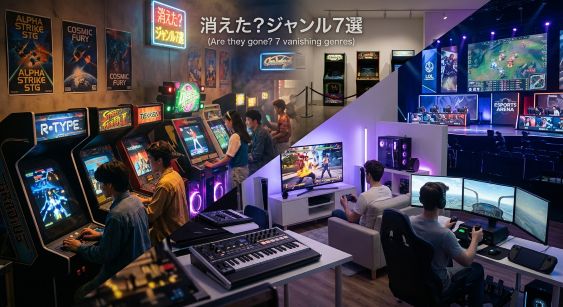
“I want to play that game I was so into as a kid again.”
“I want to learn about the history of those classic retro games I’ve seen on YouTube and social media.”
Japanese retro games are no longer merely a nostalgic cultural phenomenon; they have become a massive cultural phenomenon that is generating global enthusiasm, driven by a renewed appreciation overseas and soaring prices in the secondhand market.
However, I imagine there are many people who wonder, “Where exactly does ‘retro gaming’ begin?” or “I’d like to get a clear picture of what kinds of consoles and classic games were out there.”
In this article, we’ll explain everything from the definition of retro games in Japan to a quick reference guide featuring representative consoles and classic titles by generation, as well as specific ways to enjoy retro games in the Reiwa era.
- 1. What Is the Definition of a Retro Game? (The 20-Year Rule and Generational Boundaries)
- 2. [By Generation] Quick Reference Guide to Japanese Retro Game Consoles and Classic Games
- 3. Iconic Japanese Retro Games by Genre
- 4. Why Now? Three Reasons Japanese Retro Games Are Gaining Global Recognition
- 5. [Modern Edition] How to Play Retro Games Safely Right Now
- Summary: Learn about the history of retro games and dive into the world of classic titles
1. What Is the Definition of a Retro Game? (The 20-Year Rule and Generational Boundaries)
Although there is no strict, industry-wide definition of the term “retro games,” it generally refers to “games released more than 20 years ago” or “games played on consoles from at least three generations ago.”
- Classic Era (Showa and Early Heisei)
8-bit to 16-bit Generation (Famicom, Super Famicom, etc.) - The Dawn of 3D Graphics (Mid-Heisei Era)
: The 32/64-bit Generation (First-generation PlayStation, Sega Saturn, Nintendo 64, etc.) - New Retro (Late Heisei Era)
— The Early 2000s Generation (PlayStation 2, Nintendo GameCube, Dreamcast, etc.)
Nowadays, hardware from the early 2000s—such as the PS2 and GameCube—is also beginning to establish itself as “Heisei retro.”
2. [By Generation] Quick Reference Guide to Japanese Retro Game Consoles and Classic Games

We’ve compiled a list of the major consoles and iconic games that are essential to any discussion of the history of home video games in Japan.
The 8-Bit Era (Early 1980s–): The Dawn and Popularization of Video Games
This was the golden age when home video games exploded in popularity and gave rise to numerous popular IPs (intellectual properties) that continue to this day.
| Hardware Name | Year of Release | Developer | Features | Classic Masterpiece Games |
| Family Computer | 1983 | Nintendo | The legendary console that set the standard for home video game systems | “Super Mario Bros., ” “Dragon Quest III, ” “The Legend of Zelda” |
| Sega Mark III / Master System | 1985 | Sega | It debuted as a rival to the Famicom. High-performance graphics | “Phantasy Star” and “Alex Kidd” |
| PC Engine | 1987 | NEC Home Electronics | Although it is an 8-bit CPU, it boasts color and graphics capabilities equivalent to a 16-bit CPU | “PC Hominid, ” “Tengai Makyou ZIRIA” |
| Game Boy | 1989 | Nintendo | A groundbreaking portable game console powered by AA batteries. A massive hit worldwide. | “Pokémon Red and Green, ” “Tetris” |
The 16-bit Era (Late 1980s to Early 1990s): The Golden Age of Pixel Art
This is an era in which graphics and sound have evolved significantly, and pixel art has been refined to the utmost degree.
| Hardware Name | Year of Release | Developer | Features | Classic Masterpiece Games |
| Mega Drive | 1988 | Sega | Features the fastest 16-bit CPU. A huge success overseas (GENESIS) as well. | “Sonic the Hedgehog, ” “Puyo Puyo” |
| Super Famicom | 1990 | Nintendo | It has taken the market by storm with its zoom, resize, and rotate features, as well as its diverse sound sources | “Super Mario World, ” “Chrono Trigger, ” “Final Fantasy VI” |
| NEOGEO | 1990 | SNK | It sparked a fighting game boom with “100 Mega Shock” | “Fatal Fury, ” “THE KING OF FIGHTERS ’94” |
| Game Gear | 1990 | Sega | A full-fledged handheld game console featuring a color LCD screen | “Sonic & Tails, ” “Magic Knight Rayearth” |
The Era of 3D Polygons (Mid-1990s–): A Revolution in Expressive Power and the Shift to CD-ROMs in the Gaming Industry
This marked a turning point in the transition from 2D pixel art to 3D polygon graphics, and the media format also shifted from cassettes to high-capacity CD-ROMs.
| Hardware Name | Year of Release | Developer | Features | Classic Masterpiece Games |
| Sega Saturn | 1994 | Sega | Strengths in arcade ports. Combines 2D graphics capabilities with full-fledged 3D. | “Virtua Fighter 2, ” “Sakura Wars” |
| PlayStation | 1994 | Sony Computer Entertainment | Established 3D CG polygon graphics and gained dominance in the gaming industry | “Final Fantasy VII, ” “Resident Evil” |
| NINTENDO 64 | 1996 | Nintendo | A landmark 3D action game that offers complete freedom of movement in a 3D environment | “Super Mario 64, ” “The Legend of Zelda: Ocarina of Time” |
| Game Boy Color | 1998 | Nintendo | Compatible with Game Boy while supporting color displays | “Pokémon Gold and Silver, ” “Dragon Quest Monsters” |
3. Iconic Japanese Retro Games by Genre
Here are some landmark titles in each genre—essential for any discussion of the appeal of retro games.
JRPG (Japanese-style role-playing game)
This genre is emblematic of Japanese gaming culture. With its
rich storylines and beautiful background music, it has garnered fans all over the world.
- "Dragon Quest III: And Into the Legend…" (Famicom / 1988)
- A timeless classic that sparked a social phenomenon. Its job-change system and vast, immersive world captivated players.
- "Chrono Trigger" (Super Famicom / 1995)
- Created by a dream team consisting of Yuji Horii, Akira Toriyama, and Hironobu Sakaguchi, this is the pinnacle of time-travel RPGs.
Action Platformer
This genre is known for its intricate pixel art and exceptional level design (stage construction).
- "Super Mario Bros." (Famicom / 1985)
- This game, which perfected the fundamentals of side-scrolling action, is a landmark title in the history of video games.
- "Mega Man 2: The Mystery of Dr. Wily" (Famicom / 1988)
- With its perfectly balanced difficulty and superb background music, it is hailed as a landmark in the action game genre.
Fighting Game
It sparked a craze in amusement facilities and homes throughout the 1990s.
- "Street Fighter II" (Super Famicom, etc. / 1992)
- This smash-hit game laid the groundwork for the basics of competitive fighting games, including the use of command inputs to execute moves and “cancel moves.”
4. Why Now? Three Reasons Japanese Retro Games Are Gaining Global Recognition
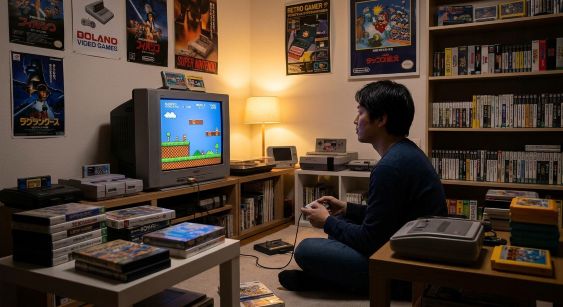
In recent years, prices for retro games have skyrocketed in Akihabara and online stores, and it has become a common sight to see tourists from overseas buying them.
There are three main reasons behind this trend.
1. The Artistic Value of Dot Art (Pixel Art)
While modern games are dominated by high-end graphics that are virtually indistinguishable from live-action footage, “pixel art”—created within the constraints of limited resolution and color palettes—is highly regarded as a distinct art form.
2. Simple yet deep gameplay
With no loading times and no complicated tutorials—it’s “playable right after turning it on”—this intuitive fun feels refreshing to today’s busy gamers.
3. The Overseas Boom in “Showa and Heisei Japanese Culture”
With the resurgence of anime and city pop from the ’80s and ’90s, video games released in Japan during that era have become collector’s items as “symbols of retro culture.”
5. [Modern Edition] How to Play Retro Games Safely Right Now
For those who think, “I’d like to play some old games, but it’s a hassle to get my hands on the original consoles or a CRT TV…,” we’ve put together a list of the most popular ways to enjoy retro games in today’s environment.
① Use a subscription service (the easiest option)
If you own a current-generation game console, using the official monthly subscription service is the safest and most convenient option.
- With Nintendo Switch Online, you can play titles from the
Famicom, Super Famicom, and Game Boy. With an add-on pack, you can also enjoy Nintendo 64 and Mega Drive games. - PlayStation Plus (Premium)
offers classic titles from the original PlayStation, PS2, and PSP.
② Buy a Mini Console (retro-style console)
This is a reissue console released by the official manufacturer that features a miniaturized version of a classic console with classic games pre-installed.
- Nintendo Classic Mini (Famicom / Super Famicom)
- Mega Drive Mini / Mega Drive Mini 2
- PC Engine mini
Simply connect it directly to a modern LCD TV or monitor via the HDMI port to enjoy high-quality video and audio.
③ Use a retro game streaming platform for PCs
If you’re playing on a PC, the official re-release streaming service is a convenient option.
- Project EGG
re-releases and distributes thousands of classic titles, focusing primarily on retro PC games from the 1980s, such as the PC-8801 and MSX. - On Steam and GOG.com, classic titles from the
past are being ported and sold individually as part of the Arcade Archives series.
④ Playing with the actual console and an HDMI converter (for enthusiasts)
If you want to experience the original atmosphere by playing on the actual console with cartridges, you can find them at secondhand stores or on flea market apps.
However, to connect older game consoles (with AV or RF ports) to a modern HDMI TV, you’ll need a converter (signal converter) or an HDMI cable designed for retro games.
Summary: Learn about the history of retro games and dive into the world of classic titles
Japanese retro games are the foundation that supported the development of today’s gaming industry, and they are a wonderful form of entertainment that can be enjoyed across generations.
- The Golden Age of Retro Games, Woven Together by 8-bit to 16-bit
Pixel Art and Iconic BGM - Innovations in Game Graphics Using 32- to 64-Bit
3D Polygons and High-Capacity CD-ROMs - How to Play:
These days, you can easily try them out on the Nintendo Switch, PS5 subscription services, or mini consoles.
Whether you want to revisit games from your childhood or try out classic titles you’ve never played before on modern platforms, we invite you to enjoy the rich and diverse world of retro gaming.