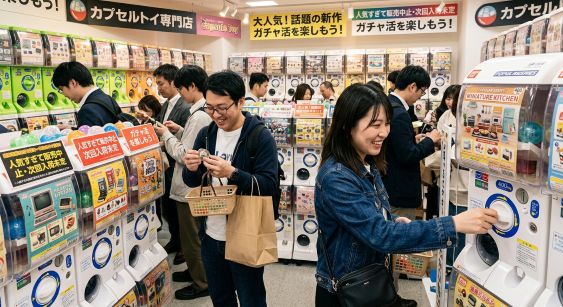
When you walk around town, you’ll see rows and rows of capsule toy (gachagacha) vending machines in corners of large shopping malls and inside train stations.
While the capsule toy market used to be strongly associated with “things kids buy with their allowance,” it is now experiencing an unprecedented “adult boom.”
It has been reported that the market size has surpassed 100 billion yen, and specialty stores—numbering in the hundreds—are popping up one after another throughout the city.
However, alongside this rapid expansion, new issues and challenges are emerging—such as “sold out the same day” or “sales suspended” due to the explosive popularity of certain items, as well as “gacha fatigue,” a term being whispered about primarily on social media.
Why are adults so obsessed with capsule toys?
And what’s really going on behind the scenes of this booming market?
In this article, we’ll explore everything from the background of the adult capsule toy boom to the challenges facing the industry and its future prospects.
- The Rapid Growth of the Capsule Toy Market in Numbers
- Why Are Adults So Obsessed with “Gacha”? 4 Factors Behind Its Success
- “Two Unusual Developments” Unfolding Behind the Rapid Expansion
- Future Outlook and Survival Strategies for the Capsule Toy Market
- Summary: Moving Toward a “Mature Phase” Beyond the Frenzy
The Rapid Growth of the Capsule Toy Market in Numbers
The capsule toy market used to be a market that sold “toys for children” in the low-price range of 100 to 200 yen, but its market structure has undergone drastic changes in recent years.
- Market Growth: According to surveys by the
Japan Toy Association and other sources, the capsule toy market continues to grow at a pace that could reach 100 billion yen, and has evolved into a major category driving the overall toy market. - Explosive Growth
of Specialty Stores: Super-large specialty stores—such as “Gashapon Department Store” and “Gachagacha Forest”—have opened in major shopping centers and station concourses across the country.
The sight of 500 to over 1,000 vending machines lined up in orderly rows has already become a common sight. - The Establishment
of a Higher Price Range (Premiumization): The price range that used to be 100 to 300 yen has now shifted, with 400 to 500 yen becoming the main price bracket.
Furthermore, high-end capsule toys costing 1,000 yen or more—featuring intricately detailed figures and products with sophisticated mechanisms—have appeared on the market, stimulating purchasing interest among adults.
Why Are Adults So Obsessed with “Gacha”? 4 Factors Behind Its Success
The reason adults are so hooked on capsule toys isn’t simply because they “bring back memories.” There are a variety of features that align with
the psychology and lifestyles of today’s adults.
(1) Miniature Culture and “Gen Z and Gen Y” Emotional Consumption
High-quality miniatures—such as retro Showa-era appliances, actual candy packaging, family restaurant menus, and familiar stationery items—that are “exact, scaled-down replicas of the real thing” are enjoying immense popularity.
For people in their 30s and 40s, they evoke “nostalgic memories,” while for Gen Z in their teens and 20s, they offer a “retro, cute, and emotional experience” that really resonates.
② Compatibility with “supporting one’s favorite” and “showcasing” in the age of social media
A trend has taken hold where people take photos of the miniatures and figures they’ve purchased alongside acrylic stands featuring their favorite characters and post them on X (formerly Twitter), Instagram, and TikTok.
The secondary use of these items on social media—such as using capsule toys as props for “plushie photography”—is further boosting consumer demand.
③ The “thrill of randomness (gacha experience)” that’s easy to enjoy
Just like the “gacha” feature in mobile games, the thrill of not knowing what you’ll get and the sense of accomplishment when you land the item you’re after provide a little stress relief in everyday life.
Another advantage is that, as a “little luxury you can buy for just a few hundred yen,” it’s something you can easily enjoy on your way home from work or while running errands.
④ Corporate Collaborations and a Dramatic Leap in Quality
Not only toy manufacturers but also food companies, home decor brands, and cosmetics brands—companies from a wide range of industries—are entering the market one after another. Thanks to advances in
molding and painting techniques, these products now boast a level of quality that belies their price of just a few hundred yen, firmly capturing the interest of adults who want to display them as home decor.
“Two Unusual Developments” Unfolding Behind the Rapid Expansion
While the boom continues to intensify, unprecedented problems are arising on both the supply side and the demand side (among consumers).
Abnormality #1: Due to overwhelming popularity, there have been a series of instances of “selling out on the same day” and “cancellations of pre-orders and sales”
Products that have gone viral on social media or been featured by well-known influencers are frequently selling out on the very day they go on sale.
In particular, official collaboration series that faithfully reproduce real-world products, as well as character merchandise designed by famous illustrators, often draw long lines as soon as the store opens and can sell out within a few hours.
Manufacturers produce these items based on demand forecasts, but since many steps in the production of capsule toys—such as mold manufacturing and painting—are carried out at overseas factories, it typically takes several months to ramp up production for a re-release.
As a result, supply cannot keep up with demand, leading to situations where people “can’t buy what they want” or where sales are “discontinued or postponed.” This has also led to a growing problem of scalpers listing items at inflated prices on flea market apps.
Trend #2: A Rising Number of Adults Complaining of “Gacha Fatigue”
At first glance, this boom seems to be going smoothly, but among consumers, a psychological shift known as “gacha fatigue” (weariness from collecting capsule toys) is beginning to emerge.
- The financial burden
of getting "suckered into the trap": With prices rising to 400 to 500 yen per play, more and more people are spending several thousand yen to nearly 10,000 yen at a time after continuing to play until they get the one item they want. This has created a sense of anxiety that "it costs as much as gacha in mobile games.
" - The Desire to Complete a Collection and the Stress
of Duplicates: In our eagerness to collect every single type (to complete the set), we face the disappointment of getting the same item over and over again, as well as the practical problem of where to store unwanted capsules. - Fatigue
from the Information War: More and more people are growing tired of constantly tracking information on social media—such as “Now in stock at Store X” or “Sold out today”—and of hopping from store to store in search of items.
Future Outlook and Survival Strategies for the Capsule Toy Market
What changes are needed to ensure that this doesn’t end as just a temporary fad, but rather that the market continues to grow sustainably?
New initiatives are already underway in the industry.
The Evolution of Smart Capsules (Cashless and Online)
To eliminate the hassle of having to find change, “cashless vending machines” that accept QR code payments and transit IC cards are rapidly gaining popularity.
In addition, the market for “online capsules”—
where users spin a virtual gacha online and have the items delivered to their homes at a later date—is also expanding. This trend is meeting the needs of consumers who cannot visit physical stores and those who want to avoid receiving duplicate items.
Commitment to Sustainability (Capsule Recycling and Eco-Friendly Materials)
To address the problem of waste generated by the massive consumption of plastic capsules, initiatives are underway, such as installing collection boxes in stores, introducing “capsule-free products” in which the capsules themselves are incorporated into the product design, and utilizing biomass plastics.
Environmental consideration has become an essential requirement for creating a market where adults can enjoy themselves with peace of mind.
Target Segmentation and Global Expansion
Going forward, we expect to see further segmentation of target audiences, such as promoting Japan’s unique culture to “international tourists (inbound)” and developing products aimed at more specialized niche markets (such as specific architectural styles, historical artifacts, and exotic animals).
Summary: Moving Toward a “Mature Phase” Beyond the Frenzy
Capsule toys have evolved from mere children’s freebies into a cultural phenomenon that captivates adults. The
“thrill of not knowing what you’ll get” and the “astonishing quality of these palm-sized items” may offer adults living in today’s stressful society a simple yet reliable source of comfort.
Despite facing challenges such as “shortages and discontinued sales” due to its popularity, as well as “gacha fatigue,” the market is moving beyond a mere passing trend and entering a “mature phase” as one of Japan’s leading entertainment industries.
Enjoying the thrill of a treasure hunt—finding your own “favorites” while maintaining a healthy sense of distance—is, I believe, the key to maintaining a long and healthy relationship with this trend.