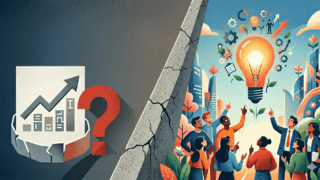
Since the launch of the new NISA, index investing—led by “Orkan”—has become the investment standard, leveraging low fees and ease of use.
At first glance, this approach of investing in the entire market seems like a rational, flawless strategy.
However, Ryu Sawakami, a professional in long-term investing, warns that this trend is robbing investors of their “thinking” and “resolve.”
While the proliferation of index investing has streamlined asset accumulation, it has also obscured the fundamental purpose of investing.
- The Vulnerability Behind Rationality and the “Rationale for Investment” Exposed During Crashes
- The Essence of Risk and the “Plus-Sum” Spirit of Walking with Companies
- A warning against “numbers-only investing” that leaves the real economy behind
- Summary: Rebuilding the “Investment Mindset” for True Prosperity
The Vulnerability Behind Rationality and the “Rationale for Investment” Exposed During Crashes
The greatest strength of index investing lies in its low cost, achieved by eliminating the expense of selecting individual companies.
However, this rationality eliminates the need for individual judgment on “why invest in that company?”
Investments lacking a reason to support a company perform well in calm markets but reveal their fragility when panic strikes.
Investors without clear decision-making criteria become emotionally swayed by price volatility, selling during crashes—which should be buying opportunities.
In contrast, investors who assess corporate value possess a resilient mindset, viewing crashes as opportunities for growth.
The Essence of Risk and the “Plus-Sum” Spirit of Walking with Companies
In modern times, risk is often misunderstood as a “danger to be avoided,” but in investing, risk is inherently the very “potential for return.”
The true essence of investing lies in supporting companies that take business risks to improve society and sharing in their growth.
The “positive-sum” world where supporting specific companies and propelling them forward enriches society as a whole is the origin of investing.
Merely riding the waves of price fluctuations carries the risk of devolving into a soulless money game, devoid of this co-creation process.
A warning against “numbers-only investing” that leaves the real economy behind
From a company’s perspective, the expansion of index investing means they are treated as “just a number.”
Ignoring the unique character of companies striving to innovate on the ground and contribute to society, treating them merely as components of an index, is not conducive to the healthy development of the real economy.
If investors lose interest in “companies with a human face,” capitalism’s self-cleansing function—nurturing quality enterprises—risks becoming dysfunctional.
We must reexamine where and how our money is moving society.
Summary: Rebuilding the “Investment Mindset” for True Prosperity
Index investing, focused solely on efficiency and cost, may indeed be a convenient tool for growing assets.
However, without “love” and “agency,” investing becomes nothing more than stacking numbers.
As Mr. Sawakami argues, it is precisely this active stance—supporting companies with the will to nurture society—that ultimately stabilizes the investor’s own heart and yields long-term fruit.
Amid the tailwind of the new NISA, we face a choice: will we merely “ride the wave,” or become “investors who create the future”?