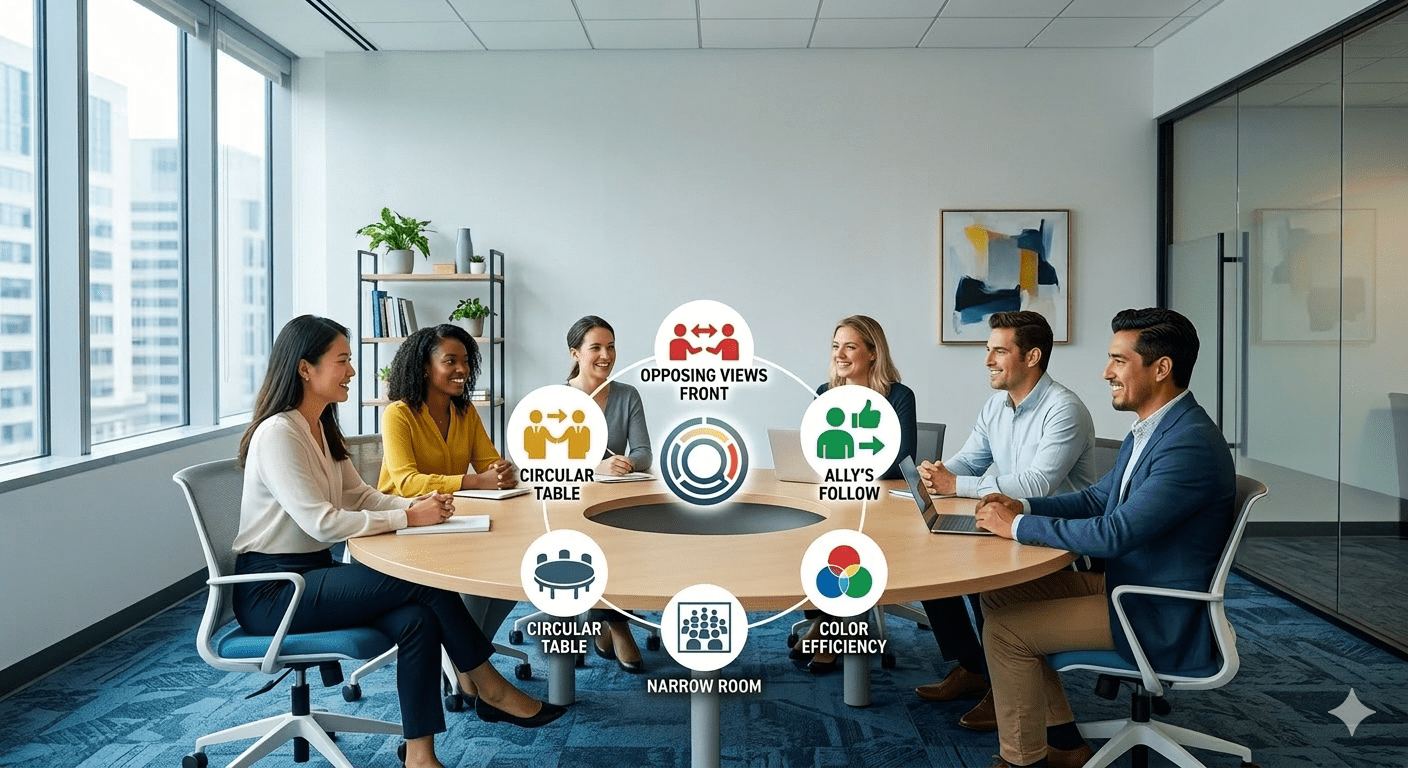
To ensure smooth decision-making on important projects, spatial strategies—such as where you sit—are just as essential as preparing materials in advance.
According to the “Three Principles of Stinzler” proposed by American psychologist Stinzler, people unconsciously reflect their psychological state in where they choose to sit.
For example, there is a tendency for people in conflict to want to sit directly across from one another, and a pattern where it is easier to voice opposing opinions to the previous speaker.
By leveraging this psychology and intentionally controlling seating arrangements, leaders can take control of the meeting and prevent discussions from stalling.
- Put Your Supporters Right in Front of You! A Technique to Accelerate Consensus Building with Support from Your Allies
- Round Tables and Right-Angle Seating Are Key! How to Create a Space That Fosters Relaxed Dialogue
- Room Size Can Change the Quality of a Discussion! Using Personal Space to Draw Out Honest Opinions
- Control Meetings with Color Psychology! The Surprising Effects of Red, Blue, and Green
- Summary: Maximize Meeting Outcomes by Strategically Arranging Seating and the Environment
Put Your Supporters Right in Front of You! A Technique to Accelerate Consensus Building with Support from Your Allies
If you want to get your proposal smoothly approved in a meeting, it’s extremely effective to deliberately seat your “allies” directly across from you.
People sitting directly across from each other tend to feel psychologically opposed to one another, but by placing compliant collaborators in this position, you can create a flow where they immediately offer positive support right after you speak.
Because people have a tendency to conform out of a fear of being excluded, having an ally voice the first opinion in favor makes it easier for others to perceive that “this is the majority opinion.”
By leveraging this psychological shift, you can dampen the momentum of opponents and dramatically speed up the overall consensus-building process in the meeting.
Round Tables and Right-Angle Seating Are Key! How to Create a Space That Fosters Relaxed Dialogue
In meetings aimed at fostering free thinking and camaraderie, it is crucial to create an environment that does not convey a sense of hierarchy.
Round tables eliminate the concept of “seats of honor” or “lower-ranking seats,” creating an atmosphere where all participants feel comfortable speaking equally.
Additionally, for one-on-one conversations requiring depth, a “right-angle arrangement”—where participants sit across from each other—is ideal.
This technique, also used by doctors and counselors, minimizes psychological pressure because eye contact isn’t direct, making it easier to relax and draw out honest opinions.
Utilizing sofas in reception rooms or open spaces without partitions is also an effective way to break down psychological barriers.
Room Size Can Change the Quality of a Discussion! Using Personal Space to Draw Out Honest Opinions
Surprisingly, the “size” of a meeting room can influence the intensity of a discussion.
If you’re hoping for lively debate and a clash of honest opinions, the best approach is to deliberately choose a slightly “smaller room.”
Since humans have a personal space, reducing physical distance stimulates psychological defense mechanisms, making it easier to spark lively discussion.
Since men tend to become more active in confined spaces while women tend to become more intimate, it is wise to choose the room size based on your specific objective.
Conversely, in situations requiring formal reports or calm judgment, selecting a spacious meeting room with ample room can help avoid emotional conflicts.
Control Meetings with Color Psychology! The Surprising Effects of Red, Blue, and Green
The final element for maximizing meeting performance is the use of “color.”
In situations where you want to encourage passionate discussions or increase the number of comments, incorporating “red”—a color that visually stimulates excitement—into the interior design or materials is effective.
On the other hand, when you want to boost efficiency during long meetings or need calm analysis, “blue”—a color that enhances concentration—proves most effective.
Additionally, if you want to ease conflicts and foster a calm atmosphere for discussion, incorporating “green”—a color with a relaxing effect—is the best choice.
In this way, by factoring in not only seating arrangements but also color psychology, it becomes possible to steer the outcomes of a meeting in the intended direction.
Summary: Maximize Meeting Outcomes by Strategically Arranging Seating and the Environment
The success of a meeting depends not only on the content of the discussion but also heavily on “environmental design”—specifically, the type of space and who sits where.
Seating arrangements based on Stinzler’s Three Principles make it easier to gain allies’ cooperation, and selecting the table shape and room size according to your objectives can dramatically improve the quality of the discussion.
Furthermore, by incorporating color psychology into the spatial design, you can even control participants’ motivation and the direction of their thinking.
At your next meeting, try strategically applying these psychological techniques to achieve smooth and productive consensus-building.