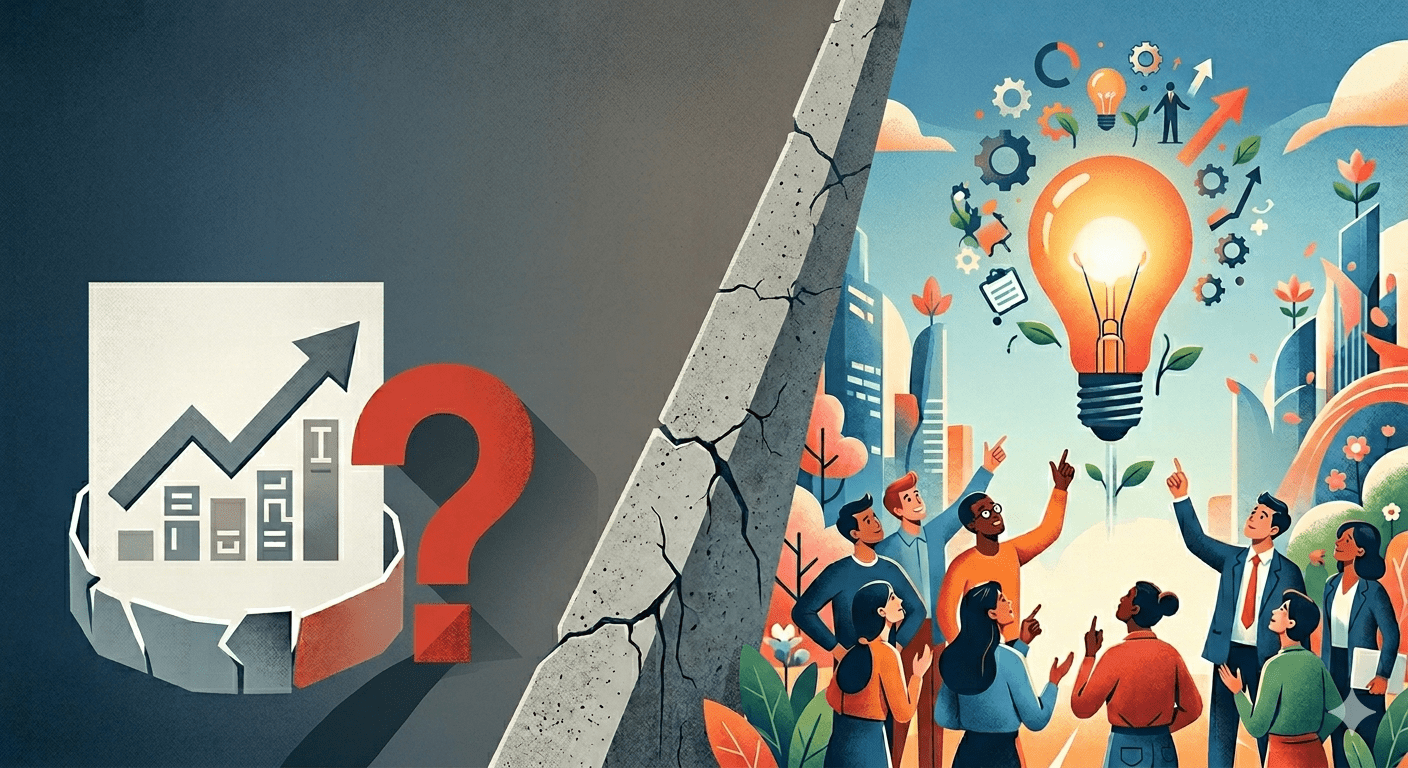
“Japan once dominated the world, so why aren’t new global companies emerging today?”
This is a pressing question that is frequently raised in today’s business world.
While giant platform companies represented by GAFA (Google, Apple, Facebook, Amazon) dominate the world, Japan has not produced innovators like the former Toyota Motor Corporation or Sony that could fundamentally reshape the industrial structure.
A multifaceted analysis of data and social structures reveals three decisive and structural differences between the Japanese people of the high-growth era and those of today—differences that go beyond mere variations in “motivation” or “ability.”
- 1. A Shift in the Nature of Desire: From the Will to Survive to the Desire for Recognition and Sustained Livelihood
- 2. The “Golden Age” and “Burden” of Demographics: The End of the Demographic Dividend
- 3. The Mismatch Between Education and Organizational Culture: The Limits of the Drive to Find the “Right Answer”
- 4. The Investment Environment and the Penalties for “Failure”
- 5. How Should We Change: Aiming for a Second Founding Era
1. A Shift in the Nature of Desire: From the Will to Survive to the Desire for Recognition and Sustained Livelihood
What drove Japan during the period of rapid economic growth (the 1950s to the 1970s) was a fierce will to survive (a “hungry spirit”)—the desire to rise from the ashes of postwar devastation and make “tomorrow better than today.”
Material deprivation was the source of innovation
For the Japanese people of that era, the richness of life was defined by “tangible possessions.”
Acquiring the “Three Sacred Treasures” (black-and-white TV, washing machine, and refrigerator) and the “New Three Sacred Treasures” (color TV, air conditioner, and automobile) was a common goal shared by the entire nation.
- The Mindset of the Past
A clear demand for “greater convenience, lower prices, and larger quantities.” - The Mindset of Today
Physical abundance has already reached saturation, and young people’s desire to consume is waning.
There is a strong status quo bias at work, driven by the desire to avoid “the risk of failing and losing one’s current lifestyle.”
From “Hungry” to “Quiet”
It is often said that today’s young people “lack ambition,” but to be precise, “the objects of their desire are not yet clear.”
According to Maslow’s hierarchy of needs, this is the phase where they should be striving for “self-actualization” after their needs for survival and safety have been met, but a sense of social stagnation is blocking that next step.
Data shows that the entrepreneurial spirit among Japanese youth ranks among the lowest in developed nations, reflecting a reality where “fear of failure” outweighs “expectations of success.”
2. The “Golden Age” and “Burden” of Demographics: The End of the Demographic Dividend
In economic development, demographic structure is a decisive factor that cannot be ignored.
During its period of rapid economic growth, Japan was in the midst of what is known as the “demographic dividend.”
The “Tolerance for Failure” Born of Youth
Japan’s population pyramid in the 1960s formed a neat triangle.
In 1960, the average age of the Japanese population was approximately 26.
In contrast, today it exceeds 48.
When there is an abundant young workforce, labor can smoothly shift from older industries to new ones as they emerge.
Furthermore, society was filled with an optimistic atmosphere where people believed that even if they failed, “there would be another chance.”
The Conservatism Brought About by the “Inverted Pyramid”
Modern Japan is in the “demographic burden” phase.
As the elderly population grows and social security costs balloon, both the government and businesses are forced to allocate resources to “defense” rather than “offense.”
- The Aging of Decision-Makers
The average age of executives at large corporations continues to rise, leading to a reversal where IT strategies are being determined by those who are not digital natives. - The Shortage of Young Talent
Valuable young talent is increasingly making the rational choice (risk hedging) to pursue stable positions at large corporations or in the civil service rather than taking risks with startups.
3. The Mismatch Between Education and Organizational Culture: The Limits of the Drive to Find the “Right Answer”
During the era when Toyota and Sony experienced rapid growth, Japan sought a “catch-up” model designed to “catch up with and surpass the West.”
An Era When “Homogeneity” Was a Weapon
During Japan’s period of rapid economic growth, the education system specialized in mass-producing a “homogeneous and highly skilled workforce” capable of working flawlessly on factory assembly lines or faithfully executing organizational orders.
In the process of producing existing products—such as radios and automobiles—with higher quality and at lower cost, Japan’s collectivism and diligence became its most powerful weapons.
Modern Organizations That Exclude “Non-Conformists”
However, modern innovation requires “creating something from nothing” and “disrupting existing rules.”
- The Downside of Peer Pressure
Japanese education and society are still deeply rooted in a culture where “the nail that sticks out gets hammered down,” and there is a tendency to exclude people who behave differently from those around them.
The “environment that embraces sharp individuality”—one that did not conform to existing frameworks, as exemplified by Sony founders Masaru Ibuka and Akio Morita—has been lost in modern Japanese organizations. - Digital Defeat
In today’s software-driven world, the legacy of hardware-centric success (the “revenge of success”) is hindering rapid pivots (changes in strategy).
4. The Investment Environment and the Penalties for “Failure”
The decisive difference between Silicon Valley and Japan lies in the tolerance for failure and the flow of capital.
The Fear That Failure Means the End of One’s Career
In Japan, the reality is that once an entrepreneur fails, the hurdles to making a comeback are extremely high.
The practice of requiring personal guarantees for loans and the harsh scrutiny of “gaps in employment” when seeking new jobs are stifling the potential of budding innovators.
Quality and Speed of Investment
During the period of rapid economic growth, bank loans were the primary source of funding, and capital flowed into growth sectors in tandem with industrial policy.
While investment in startups is on the rise today, it remains orders of magnitude smaller compared to the United States or China. In particular, there is a severe shortage of large-scale venture capital needed to nurture “unicorn companies” (unlisted companies valued at over $1 billion).
5. How Should We Change: Aiming for a Second Founding Era
The statement, “Japan will never produce another Toyota or Sony,” is, in essence, a warning that “the old methods won’t work.”
After squarely facing the harsh reality revealed by the data, the path we should take can be summarized in the following three points.
- A Paradigm Shift from “Things” to “Experiences”
Rather than fixating on improving tangible products, we must rebuild our business models to center on software, services, and customer experiences. - Turning Failure into an Asset
We must build a social system that views failure not as a “disgrace” but as “valuable experience (data).” - Empowering Younger Generations
We must implement structural reforms that enable the digital native generation—those in their 20s and 30s—to hold capital and decision-making authority.
If we can channel the “passion” that characterized the Japanese people during the era of rapid economic growth into solving today’s challenges, Japan will surely once again become a force that astonishes the world.
This does not mean simply imitating the Sony of the past, but rather the birth of an entirely new type of “global company originating in Japan.”
[Summary of this article]
- The Dwindling Spirit of Ambition
With basic survival needs met, the motivation to take risks has waned. - The Shackles of Demographics
The aging of society as a whole is leading to conservative decision-making. - Educational System Fatigue
An education system focused on imitation and incremental improvement cannot keep pace with disruptive innovation. - Recommendations for the Future
We need a new ecosystem that discards past successes and embraces failure.









'%3E%3Cpath%20stroke='%23000'%20stroke-width='4'%20d='m-35-37-13%2020m5%203%2013-20m5%203-13%2020m63%2042%206-9m1-2%206-9m5%203-6%209m-1%202-6%209m5%203%206-9m1-2%206-9m-96%200%2013%2020m5-3-6-9m-1-2-6-9m5-3%2013%2020m63-42-6-9m-1-2-6-9m5-3%2013%2020m5-3-6-9m-1-2-6-9'/%3E%3Ccircle%20r='24'%20fill='%23cd2e3a'/%3E%3Cpath%20fill='%230047a0'%20d='M0%200a12%2012%200%201%201%2020%2013%2024%2024%200%201%201-40-26A12%2012%200%201%200%200%200'/%3E%3C/g%3E%3C/svg%3E)