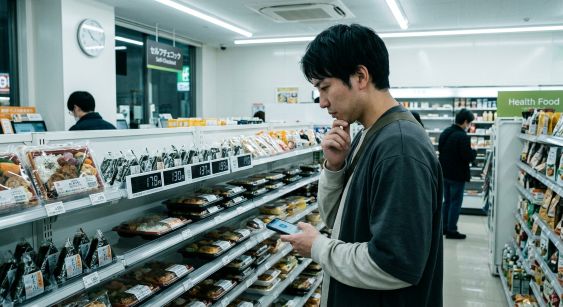
“I’ve been going to convenience stores less often lately,” “My total shopping bill seems higher than it used to be”—there are quite a few people who feel this way.
Convenience stores once boasted unparalleled convenience as a staple of daily life, but in recent years, there have been reports of a so-called “decline in convenience store usage,” marked by stagnant customer numbers and a plateau in the number of stores.
In this article, we’ll explain the four structural reasons behind the trend of customers turning away from convenience stores, the latest strategies of the three major chains (7-Eleven, FamilyMart, and Lawson), and the future direction of the industry.
- Why Are People Turning Away from Convenience Stores? Four Reasons
- The Latest Developments and Survival Strategies of the Three Major Companies
- How Will the Convenience Store Industry Change in the Future?
- Summary: The Shift Away from Convenience Stores Marks the Dawn of an Era of “Redefining Convenience”
Why Are People Turning Away from Convenience Stores? Four Reasons
The decline in the frequency of convenience store visits is driven not only by cyclical economic fluctuations but also by structural factors such as changes in consumer behavior and the competitive landscape.
(1) A growing perception that prices are “overvalued” due to rising prices
Due to rising costs of raw materials and logistics, prices for staple items such as rice balls, boxed lunches, and soft drinks have been increasing one after another.
As the price gap with supermarkets and drugstores has widened, the perception among consumers that “convenience stores are expensive” has grown even stronger.
② Decline in reasons for visiting the store (hooks)
The factors that have traditionally been major drivers of in-store visits are gradually losing their influence.
- With the spread
of cashless payments, the use of cash has declined, and opportunities to use in-store bank ATMs have decreased. - The shift away from traditional cigarettes—driven by declining
smoking rates and the transition to heated tobacco products—has led to a decrease in the number of regular customers. - As
various procedures and payments become increasingly digitized through the shift to a paperless system, the demand for in-store payments is changing.
③ The Rise of Competing Business Models (Drugstores and E-commerce)
Drugstores, in particular, have seen their market presence expand rapidly.
With their wide selection of affordable food and daily necessities, they have established themselves as “cheap and convenient.”
Furthermore, the growing popularity of online grocery shopping and same-day delivery services has relatively diminished the convenience stores’ advantage of meeting the “I want it now” demand.
④ A decline in the in-store experience due to staff shortages
The severe labor shortage is also affecting the quality of store operations.
Issues such as delays in restocking, inadequate cleaning, inconsistent customer service, and even a reevaluation of late-night hours are making it difficult to maintain the traditional strength of being “perfectly convenient at any time.”
The Latest Developments and Survival Strategies of the Three Major Companies
Amid these headwinds, the three major companies are each taking different approaches to retain their customers.
| Brand | Key Strategic Approaches | Features and Strengths |
| 7-Eleven | High Value-Added and Quality-Oriented | A strategy focused on maximizing the quality of private-label (PB) products to the utmost and providing value that exceeds the price. Differentiation is achieved through high-quality prepared foods and limited-edition desserts. |
| FamilyMart | Expansion of the Mid-Priced Segment and Everyday Goods | Expanding the “Famimaru” line, which offers great value, and strengthening the lineup of daily necessities. We strive for a well-balanced selection that’s easy to use in everyday life. |
| Lawson | Expertise and Brand Collaborations | The company has developed strong proprietary brands such as “Uchi Café” and “Karaage-kun.” It maintains a dedicated fan base through collaborations with famous restaurants and the establishment of specialty stores. |
How Will the Convenience Store Industry Change in the Future?
As traditional business models reach their limits, the convenience store industry is expected to shift in the following directions going forward.
- A Shift from “Low Prices and Convenience” to “High Quality and Expertise”: There is a growing trend to avoid
price competition with drugstores and instead focus on exclusive products available only at these stores and ready-to-eat prepared foods. - Flexibility in Business Operations (Reevaluation of 24-Hour Operations)
: Rather than a uniform 24-hour operation across all stores, the practice of setting operating hours based on location and demand will become even more widespread. - In addition to the standardization
of self-checkout systems driven by labor-saving technologies and the active adoption of AI, efforts are underway to implement unmanned nighttime operations and optimize ordering and inventory management using AI. - Community Focus and Redefining Lifestyle Infrastructure Functions: Beyond serving
merely as retail outlets, these locations are expected to provide community-based value-added services, such as assistance with administrative procedures and serving as local consultation centers for health and lifestyle issues.
Summary: The Shift Away from Convenience Stores Marks the Dawn of an Era of “Redefining Convenience”
The real reason behind the shift away from convenience stores is not that consumers have grown to dislike them, but rather that their standards and options regarding “convenience” have changed.
From the traditional model of “convenience stores that are everywhere, inexpensive, and open 24 hours a day” to a new model that offers “value worth paying for, even at a higher price” and “serves as essential local infrastructure”—
the convenience store industry is currently undergoing a major transformation.